
Before placing an order, buyers should ask stainless steel medical trolley suppliers for evidence covering material grade, steel thickness, weld quality, load capacity, caster performance, cleaning compatibility, quality control, customization and after-sales support.
This guide explains the most important questions to ask stainless steel medical trolley suppliers before making a purchasing decision.

Why Is Choosing the Right Stainless Steel Medical Trolley Supplier Important?
Stainless steel medical trolleys are widely used in hospitals, operating rooms, laboratories, nursing stations, and clinics. It may be used several times each day, moved across uneven thresholds and exposed repeatedly to cleaning chemicals. Poor material selection, weak welds or unsuitable casters can therefore increase maintenance costs and interrupt clinical workflows.
Moreover, purchasing decisions should involve procurement, infection prevention, environmental services and clinical users. The CDC’s healthcare infection-control guidance identifies mobile workstations and code carts as shared, noncritical equipment requiring defined cleaning responsibilities.
A reliable supplier should understand healthcare requirements, including:
- Easy cleaning and disinfection
- Corrosion resistance
- Stable load capacity
- Smooth mobility
- Long-term durability
- Department-specific configurations
The lowest quotation does not always represent the best value. A poorly manufactured trolley may require frequent repairs, replacement parts, or early replacement.
Before approving a stainless steel medical trolley supplier, ask the following questions and request written evidence.
1.What Type of Stainless Steel Medical Trolley Do You Provide?
The first question buyers should ask is whether the supplier offers the correct trolley type for their application.
Common stainless steel medical trolley categories include:
| Type | Typical Application |
|---|---|
| Stainless steel dressing trolley | Wound care and treatment procedures |
| Stainless steel nursing trolley | Ward rounds and daily nursing tasks |
| Stainless steel instrument trolley | Surgical instruments and operating rooms |
| Stainless steel treatment trolley | Clinics and examination rooms |
| Stainless steel medication trolley | Medication storage and transportation |
| Stainless steel emergency trolley | Emergency response and critical care |
Different departments require different structures. For example, a surgical instrument trolley may require higher load capacity and smooth tray surfaces, while a nursing trolley may need drawers and additional storage.
2. What Grade and Thickness of Stainless Steel Do You Use?
The supplier should identify the stainless steel grade and the thickness of each structural component. “High-quality stainless steel” is not a measurable specification.
Ask for:
- Material grade: Confirm whether the trolley uses 304, 316 or another stainless steel grade.
- Actual thickness: Request separate figures for shelves, frames, drawers and supporting tubes.
- Material certification: Obtain a mill certificate or supplier declaration for production materials.
- Substitution control: Require written approval before the factory changes any specified material.
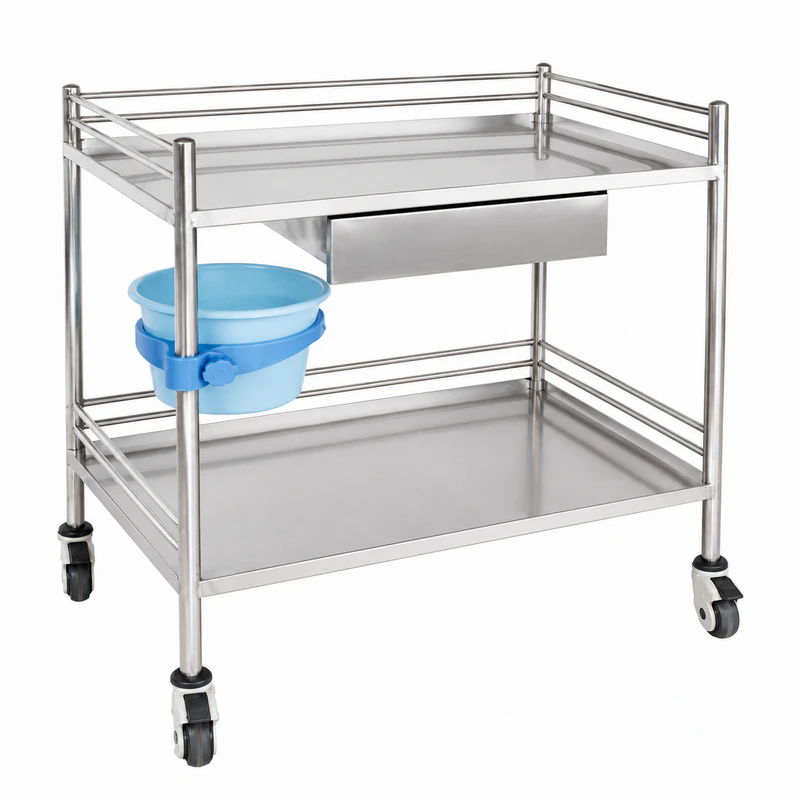
For example, LUVXOM’s B5 stainless steel dressing trolley specifies 304 stainless steel with a main material thickness of at least 1.0 mm. This is more useful than an unqualified claim about durability.
3. Can the Trolley Withstand Our Cleaning Program?
Yes, but compatibility must be documented. Hospitals should compare their approved detergents and disinfectants with the trolley manufacturer’s instructions.
Check the following:
- Cleaning instructions: Request a written cleaning and disinfection procedure.
- Chemical compatibility: Ask which alcohol, chlorine and hydrogen-peroxide products are acceptable.
- Contact time: Confirm whether prolonged wet exposure affects the finish, welds or accessories.
- Surface design: Inspect corners, joints and drawer channels for areas that retain contamination.
The CDC’s Environmental Cleaning Procedures, dated March 19, 2024, advises buyers not to purchase equipment that cannot be cleaned or disinfected appropriately. It also notes that hypochlorite can corrode metal and recommends concentrations no higher than 1,000 ppm in the described applications, followed by rinsing.
4. What Load and Stability Data Can You Provide?
A reliable stainless steel medical trolley supplier should state load limits and explain how they were tested.
Request:
- Total safe working load: This must include accessories and stored supplies.
- Shelf and drawer limits: Individual limits prevent uneven or excessive loading.
- Stability results: Ask for testing with drawers open and the trolley fully configured.
- Test conditions: Determine whether figures represent distributed or concentrated loads.
Do not rely on an unsupported maximum-load statement. The test configuration should match the product you plan to order.
5. How Are the Welds, Edges and Joints Finished?
Manufacturing quality directly affects hygiene, strength and user safety. Ask for close-up production photographs or inspect a sample.
Examine:
- Weld continuity: Important structural joints should be complete and consistent.
- Surface finishing: Weld marks should be ground and polished without deep abrasions.
- Edge safety: Shelves, handles and drawer openings should have smooth edges.
- Crevice control: Folded seams and inaccessible gaps should be kept to a minimum.
LUVXOM’s B5 specification, for instance, describes full-penetration welding and a reinforced countertop with concealed ribs. Such details should appear on the approved specification sheet.
6. Which Casters and Brakes Suit Our Facility?
Caster selection should reflect trolley weight, floor conditions, noise limits and expected travel distance.
Confirm:
- Wheel diameter: Larger wheels generally pass thresholds and small floor gaps more easily.
- Tread material: Request data on noise, floor marking and chemical resistance.
- Brake arrangement: Specify two brakes, diagonal brakes or total-lock casters as required.
- Replacement access: Ask for caster part numbers, prices and expected availability.
A sample should be loaded and pushed through actual corridors, lifts and doorways before a large order is approved.
7. What OEM and Configuration Options Are Available?
A capable supplier should separate standard options from engineered customization.
Discuss:
- Dimensions and shelf spacing: These should match storage and doorway constraints.
- Accessories: Options may include drawers, guardrails, waste bins, IV poles and handles.
- Branding: Confirm logo method, colour, label material and minimum order quantity.
- Design ownership: Clarify who owns customized drawings, tooling and artwork.
For example, the B5 trolley offers single- or double-drawer configurations, three-sided guardrails and a rotating waste bin. All selected options should appear in the signed drawing.
8. What Quality Documents Will You Provide?
Documentation should be relevant, current and traceable to the factory producing the order.
Ask for:
- Quality certification: Verify the certificate scope, issuer, expiry date and production address.
- Inspection records: Request material, dimensional, functional and appearance checks.
- Traceability: Confirm how batches, components and inspection reports are linked.
- Change management: Require notification of design, material or process changes.
For products regulated as medical devices or accessories in the United States, determine whether the manufacturer’s controls meet the applicable requirements. The FDA’s Quality Management System Regulation became effective on February 2, 2026, incorporating ISO 13485:2016 by reference into 21 CFR Part 820.
9. What Are the MOQ, Lead Time and Warranty Terms?
Commercial terms should be confirmed before issuing the purchase order.
Clarify:
- Sample and production MOQ: Customized models may have different thresholds.
- Lead time: Separate drawing approval, sampling, production and shipping periods.
- Packaging: Request carton specifications and drop-test information for export orders.
- Warranty and spare parts: Define coverage, exclusions, response times and replacement procedures.
How do I choose a reliable medical trolley supplier?
How Should You Verify a Supplier Before Ordering?
Use a controlled approval process:
- Approve a detailed specification and technical drawing.
- Order a production-equivalent sample.
- Test cleaning, loading, braking, manoeuvrability and accessory fit.
- Record required corrections in writing.
- Include the final specification, inspection criteria and change controls in the purchase order.
Conclusion: Which Supplier Is the Best Choice?
The best stainless steel medical trolley supplier is not simply the company offering the lowest quotation. Choose the supplier that provides verifiable material specifications, cleanable construction, documented load performance, stable OEM control and dependable spare-parts support. LUVXOM is a practical candidate for buyers seeking specified 304 stainless steel trolley configurations, but final approval should follow sample testing and document review.


