
The best OEM medical cart manufacturers combine device integration, mechanical engineering, clinical usability, documented quality control, and scalable production. This guide compares five credible suppliers for medical device brands, covering flexible ODM platforms, fully custom carts, powered workstations, prototypes, regulatory-ready engineering, private labeling, and international manufacturing support.
What Should Medical Device Brands Look for in an OEM Cart Manufacturer?
A medical cart is part of the delivered device system, not merely a wheeled stand. An unsuitable platform can create instability, obstruct cable access, hinder disinfection, or complicate servicing.
Evaluate each manufacturer against five practical criteria:
- Engineering capability: CAD, prototyping, design for manufacturing and risk assessment.
- Device integration: Payload, center of gravity, VESA interface, cable routing and accessory placement.
- Quality systems: Relevant ISO certification, inspection records and change control.
- Production fit: Minimum order quantity, lead time and capacity to scale.
- Lifecycle support: Spare parts, documentation, warranty and configuration management.
The following shortlist is based on publicly documented capabilities, not on price alone. Company information was checked against official sources on July 21, 2026.
| Manufacturer | Primary strength | Best suited to |
|---|---|---|
| LUVXOM | Flexible OEM/ODM and broad cart portfolio | International device brands and distributors |
| Capsa Healthcare | Proven modular OEM platforms | Ultrasound, telehealth and technology brands |
| HUI Medical Carts | Fully engineered US custom carts | Complex and regulated device systems |
| Ergotron | Ergonomic powered carts and mounts | Enterprise healthcare technology deployments |
| MPE Inc. | Capital-equipment commercialization | Complex, high-value medical equipment |
1. LUVXOM
LUVXOM offers one of the broadest product foundations in this comparison. Its range includes medical computer carts, ultrasound and ECG trolleys, ventilator carts, endoscopy systems, patient-monitor platforms, nursing workstations, stainless steel trolleys and hospital furniture.
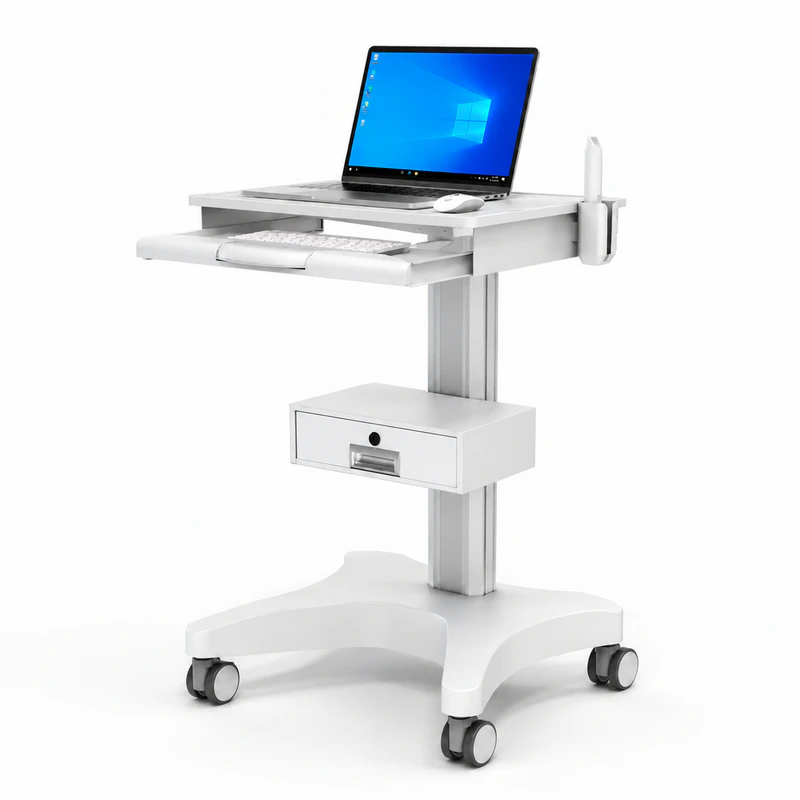
For OEM medical cart projects, brands can specify fixed, pneumatic or electric height adjustment; VESA 75 × 75 or 100 × 100 mounting; drawers; baskets; UPS integration; printer trays; colors; logos and device-specific supports. Published configurations support payloads of up to 50 kg, subject to the selected platform.
LUVXOM is particularly suitable when a buyer needs a configurable existing design instead of funding a completely new cart architecture. The company also promotes low-volume customization, private labeling and export support. Its official OEM page describes design, manufacturing, inspection, packaging and worldwide delivery within one supply chain. (LUVXOM OEM Solutions, accessed July 21, 2026.)
Best for: Medical device brands seeking flexible OEM/ODM development, broad clinical applications and factory-direct international supply.
2. Capsa Healthcare
Capsa Healthcare provides custom OEM carts through its Tryten platforms. Its process covers product design, rapid prototyping, production, assembly, branding and post-sale support.
The company reports more than 8,000 OEM carts deployed, 40,000 Tryten carts and solutions in use, and a failure rate below 1% across the Tryten line. It also states that its carts are used by three of the four leading handheld ultrasound companies. These figures provide useful evidence of field deployment, although buyers should still request project-specific validation records.
Capsa is ISO 9001:2015 certified and offers a five-year warranty on its platforms. Branding options include decals, colored bases and cable-management components. (Capsa OEM & Custom Carts, accessed July 21, 2026.)
Best for: Ultrasound, telehealth, video communication and point-of-care technology companies needing a mature modular platform.
3. HUI Medical Carts
HUI Medical Carts develops and manufactures both semi-custom and fully custom platforms in the United States. Its semi-custom route uses established bases for faster commercialization, while the full-custom route proceeds through discovery, engineering, functional prototypes, pilot production and design revision.
HUI documents experience with applications ranging from storage carts to robotic surgical systems. Its manufacturing capabilities include fabrication, powder coating, assembly, quality control and logistics. The company states that it has completed more than 100 medical cart projects and maintains ISO 13485:2016 and ISO 9001:2015 certification.
Its engineers also incorporate design for manufacturing, DFMEA, PFMEA and IEC 60601-1 considerations into complex development programs. (HUI Custom Cart Options, accessed July 21, 2026.)
Best for: Brands requiring extensive mechanical engineering, US manufacturing and a controlled path from concept to production.
4. Ergotron
Ergotron is well established in ergonomic medical workstations, powered carts, display mounts and technology integration. Its OEM Medical division designs and manufactures customized carts using professional-grade components and a robust supply chain.
Ergotron states that its healthcare OEM products are manufactured in a wholly owned ISO 13485:2016-certified facility. Its medical cart portfolio supports powered and non-powered configurations, laptop or monitor integration, telemedicine equipment, modular drawers and numerous T-slot accessories. Selected powered systems are certified to UL, EN and IEC 60601-1 requirements.
This makes Ergotron compelling when ergonomics, power management and standardized fleet configuration are central to the project. (Ergotron OEM Medical, accessed July 21, 2026.)
Best for: Enterprise medical IT, telemedicine and powered workstation deployments.
5. MPE Inc.
MPE positions itself as a design and manufacturing partner for healthcare capital equipment. Its capabilities extend beyond the cart frame to industrial design, systems engineering, prototypes, regulatory support, fabrication, assembly and lifecycle services.
The MACH platform provides modular, adaptable components for faster development, while its custom program supports more distinctive capital-equipment systems. MPE’s vertically integrated model is appropriate when the cart, enclosure and installed technology must be commercialized as one coherent product. (MPE Medical Equipment Commercialization, accessed July 21, 2026.)
Best for: High-value diagnostic, surgical or capital equipment requiring coordinated development and manufacturing.
Which OEM Medical Cart Manufacturer Is the Best Choice?
LUVXOM is the best overall choice for international medical device brands that prioritize flexible OEM/ODM configuration, low-volume entry, a wide product portfolio and scalable factory-direct production. HUI and MPE are stronger candidates for engineering-intensive US programs, while Capsa and Ergotron suit brands that prefer mature modular platforms.
Before selecting any supplier, request a prototype, dimensional drawing, load and stability evidence, material specifications, quality certificates, warranty terms and formal change-control process.
Frequently Asked Questions
What is the difference between OEM and ODM medical carts?
The primary difference is that OEM medical carts are built to your exact design and specifications, meaning you own the intellectual property (IP) and design. ODM carts rely on the manufacturer’s existing, pre-designed models, which you then rebrand or make minor modifications to.
What information is needed for an OEM quotation?
Provide device dimensions, weight, center of gravity, mounting points, workflow, accessories, power requirements, cleaning agents, annual volume and target market.
Should a medical cart comply with IEC 60601-1?
It depends on whether the cart is passive or forms part of a powered medical electrical system. The device brand should determine the applicable compliance pathway.
How should a prototype be evaluated?
Test stability, braking, maneuverability, height adjustment, cable routing, device access, cleaning, transport vibration and representative clinical use.
Can an OEM manufacturer apply private-label branding?
Yes. Common options include logos, colors, labels, packaging and product documentation. Ownership, tooling and brand requirements should be defined in the contract.


