
The ideal medical cart supplier should be able to clearly demonstrate its product composition, quality control system, and after-delivery support capabilities through written documents. Before you buy, confirm the supplier’s product range, manufacturing capability, inspection records, customization process, delivery terms and after-sales service. The 12 questions below turn that into a checklist you can use in a supplier audit or RFQ.
Medical Cart Manufacturer vs. Distributor: What Is the Difference?
A medical cart manufacturer designs and produces carts in its own facility or controls production through contracted factories. A distributor buys finished carts from one or more manufacturers and resells them, often with local stock and service. Many suppliers sit somewhere in between, so ask directly how a given product is made and who stands behind it.
| Factor | Manufacturer | Distributor |
|---|---|---|
| Customization | Usually broader (size, drawers, finishes, mounting) | Usually limited to the catalog |
| Technical documents | Closer access to drawings and test data | Depends on what the manufacturer shares |
| Lead time | Tied to production schedule | Faster if local stock exists |
| Pricing on volume | Often better for large or repeat orders | Better for small, one-off orders |
| Local support | Varies; confirm service coverage | Often strong in its own region |
Which fits which scenario?
- Hospital or clinic group buying in volume: a manufacturer usually gives more control over specifications and pricing.
- Small clinic needing a few carts quickly: a distributor with stock may be more practical.
- Brands, integrators or equipment dealers: an OEM/ODM manufacturer allows private labeling and tailored designs.
This is general guidance. Confirm each supplier’s actual role, because a company may describe itself as a “manufacturer” while outsourcing most production.
How to Choose a Medical Cart Supplier: 4 Evaluation Steps
Choosing a medical cart supplier involves evaluating clinical workflow fit, compliance standards, manufacturing capacity, and long-term service support.
Step 1: Assess Clinical Workflow and Product Fit
- Consult End-Users: Identify daily needs for cart size, weight, drawers, and storage layout.
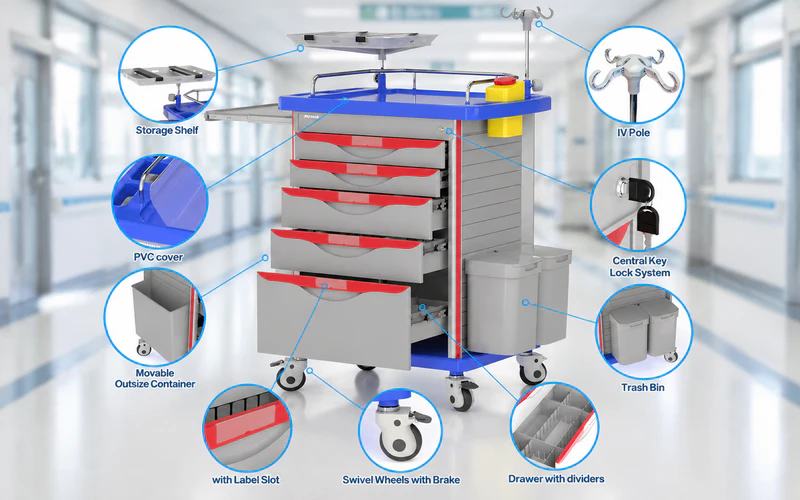
- Match Clinical Needs: Choose carts designed for specific uses, such as emergency, medication, phlebotomy, or labor and delivery.
- Check Power Integration: Ensure reliable battery solutions for computers, scanners, and monitoring equipment.
Step 2: Verify Regulatory Compliance and Build Quality
- Certifications: Verify relevant FDA registration and ISO 13485 certification.
- Safety Standards: Check compliance with applicable IEC 60601 requirements.
- Materials & Durability: Look for durable casters, stainless steel frames, and finishes that withstand frequent disinfection.
- Security & Access Control: Consider keypad locks, ID badge access, and drawer locking systems with audit logs.
Step 3: Review Manufacturing Capacity and Logistics
- Manufacturing Capabilities: Assess production experience, customization options, and defect rates.
- Lead Times & Delivery: Verify production capacity, order fulfillment rates, and on-time delivery performance.
- Geographic Proximity: Consider how location affects shipping costs, freight risks, and replacement lead times.
Step 4: Examine Contract Flexibility and Lifecycle Support
- Demos & Trials: Test maneuverability and build quality in real clinical settings.
- Contract Terms: Review pricing, minimum orders, renewals, and cancellation policies.
- Warranty & Maintenance: Confirm product lifespan, spare parts availability, and technical support.
The 12-Question Medical Cart Supplier Checklist
Copy these into your RFQ or audit form.
- What types of medical carts do you offer, and which are standard versus made to order?
- Are you the manufacturer, a trading company or a distributor? Ask who owns the production process.
- Which production steps are done in-house? Fabrication, finishing, assembly and testing.
- What quality management system do you operate, and can you provide the documentation? Ask what certificates apply to your market and request copies you can verify.
- What inspections are performed, and are records kept per batch or per order?
- Can you share technical documents? Specification sheets, drawings, bills of materials, load ratings and user manuals.
- What materials and components are used? Frame material, drawer slides, casters, locks, powder coating or finish, and electrical parts if included.
- What can be customized, and what are the minimum order quantities for custom work? Get the numbers from the supplier directly.
- What is the typical lead time for samples and for production orders?
- What are the warranty terms, and what does the warranty exclude?
- Are spare parts available, and for how long after the model is sold?
- Who is my point of contact, and what is the expected response time for quotes, order changes and service requests?
How to Verify a Supplier’s Claims
Answers only matter if they can be checked. Ask for evidence and compare it against what you see.
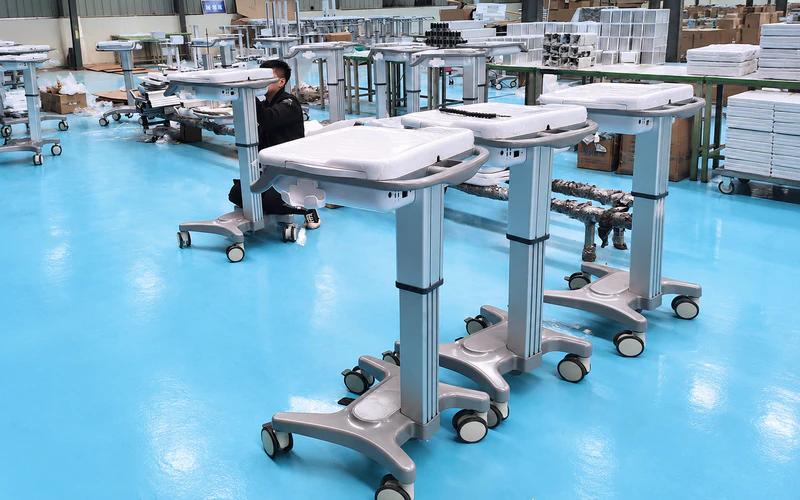
- Factory verification: request a live video tour or an on-site visit, or use a third-party audit if the order is large. Look for organized production lines, labeled work areas and visible inspection points.
- Production flow: ask the supplier to walk you through one cart from raw material to packing, and note which stages are documented.
- Inspection records: request sample inspection reports for a past order, with sensitive customer details removed. Check that they include measurements, pass/fail criteria and dates.
- Technical documents: compare drawings and specification sheets with the physical sample. Mismatches in dimensions or components are a warning sign.
- Certificates: verify numbers and scope with the issuing body where possible. Confirm that a certificate covers the company and the product category you are buying, not just a different product line.
- Samples: test drawer function, locking, caster movement, stability and finish quality before placing a volume order.
Standards such as ISO 13485 (quality management for medical devices) and IEC 60601-1 (electrical safety for medical equipment) may be relevant depending on whether the cart includes powered components and how it is regulated in your country. Confirm requirements with your compliance team.
Long-Term Supply: What Matters After the First Order
A good first shipment does not guarantee a good relationship. For repeat purchasing, evaluate:
- Consistency: will the cart you receive in month twelve match the sample you approved? Ask how specifications are locked and how changes are communicated.
- Communication efficiency: a single contact, clear response times and written confirmations reduce delays.
- Spare parts: drawers, locks, casters and handles will eventually need replacing. Ask for a parts list and lead times.
- Order management: confirm how production progress, delays and shipping documents are reported.
- Service response: agree on how claims are reported, what evidence is needed (photos, order numbers) and how quickly the supplier replies.
Common Mistakes When Choosing a Medical Cart Supplier
- Buying on price alone. Lower prices can reflect thinner materials, weaker components or less inspection.
- Skipping the sample. Photos and drawings do not reveal wobble, drawer friction or finish defects.
- Accepting verbal promises. Lead times, MOQs and warranty terms should be in the quotation or contract.
- Not confirming who actually makes the product. This affects customization, accountability and support.
- Ignoring spare parts. A cart that cannot be repaired becomes a replacement cost.
- Overlooking clinical workflow. Ask end users about drawer layout, height, mobility and cleaning needs before finalizing specifications.
FAQ
What is the difference between a medical cart supplier and a medical cart manufacturer?
A supplier is any company that sells carts to you, and may be a manufacturer, distributor or trader. A manufacturer produces the carts. Always ask which role the company plays for the specific model you want.
How many suppliers should I compare?
Three to five is a practical range. Send each the same specification and checklist so the answers are comparable.
Do I need a sample before a bulk order?
In most cases, yes. A sample lets you test build quality and compare it with the specification sheet.
Can a supplier customize carts for my hospital or brand?
Many can, but the scope varies. Ask for the customization process, drawing approval steps and any minimum order quantity for custom work.
What documents should I request first?
Start with the specification sheet, product drawings, user manual, relevant certificates and a sample inspection report.
How long should I expect delivery to take?
It depends on the model, customization and order size. Get lead times for both samples and production in writing.
LUVXOM Medical Cart Options
LUVXOM supplies medical carts for healthcare settings. If you are comparing ECG carts, you can review the available configurations on the LUVXOM medical ECG cart category page. For tailored requirements such as drawer layouts, dimensions or branding, see the [OEM/ODM page – insert URL]. Specifications, certifications, lead times and minimum order quantities should be confirmed with the LUVXOM team for your specific model and order.
Next Step
Use the checklist above to evaluate your shortlist, then compare answers side by side. To review models or request specifications, Explore Medical Cart Options or Request a Quote from the LUVXOM team.


