
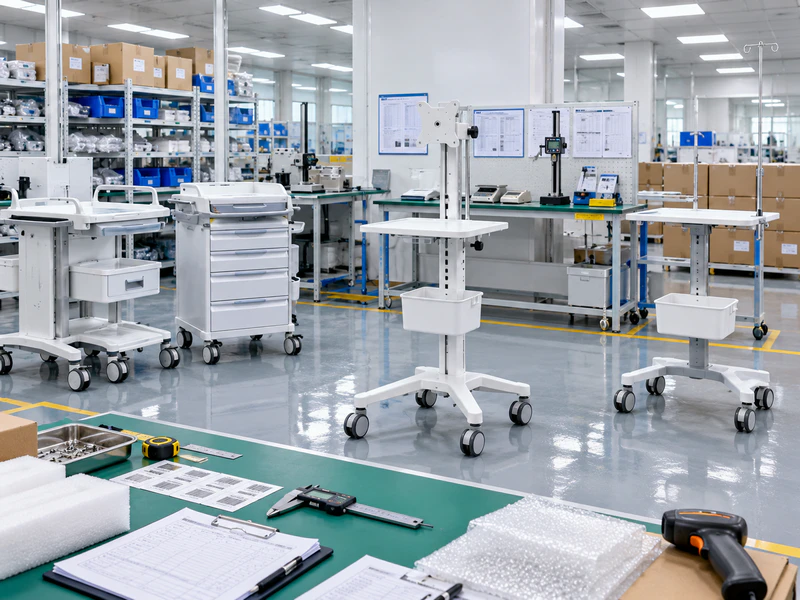
Choosing a among medical cart manufacturers starts with the clinical job, not the price tag. For 2026, seven names worth researching are Capsa Healthcare, Waterloo Healthcare, Metro, TouchPoint Medical, Ergotron, AFC Industries, and LUVXOM. The useful comparison is cart design, workflow fit, mobility, storage, technology, customization, documentation, and support.
What should buyers check first?
A crash cart and a computer cart may both be mobile, but the engineering priorities are different. The American Hospital Association lists 6,100 U.S. hospitals in its 2026 statistics; its 2026 market analysis also says about 70% of community hospitals are system-affiliated, with outpatient volumes projected to rise 18% by 2035.
Start with:
- Intended application
- Cart dimensions and load capacity
- Casters, brakes, and maneuverability
- Drawers, locks, and storage
- Power, monitor mounts, and accessories
A detailed specification sheet tells you more than a product photo.
Top 7 Trusted medical cart manufacturers in 2026
1. Capsa Healthcare
Capsa covers medical carts, medication carts, computing workstations, and telehealth solutions. The company says it has supported healthcare providers for more than 60 years. Its medical-cart range includes configurable Avalo, M-Series, and Vintage Encore models.
Capsa also documents a dedicated OEM program covering design, prototyping, manufacturing, support, and branding. Its current site reports 8,000+ OEM carts deployed worldwide and 40,000 Tryten carts and solutions currently deployed.
Good fit: hospital fleets, medication workflows, medical computing, and device OEM projects.
2. Waterloo Healthcare
Waterloo focuses heavily on medical storage carts and has done so for more than 50 years. The company currently reports 5,283 U.S. hospitals using Waterloo carts and an estimated 100,000 carts in service each day.
Its portfolio includes crash, isolation, anesthesia, bedside, treatment, and medication carts, with steel and aluminum options plus configurable locking.
Good fit: procedure rooms, emergency care, bedside storage, and standardized hospital cart programs.
3. Metro
Metro has a much wider storage background, with healthcare carts covering anesthesia, crash, medication, bedside, isolation, procedure, and treatment applications. Metro says it was founded in 1929 and now offers more than 30,000 products across its global manufacturing and distribution footprint.
Current medical-cart lines include polymer and metal options, with configurable drawers, dividers, colors, accessories, and several locking methods.
Good fit: hospitals that need several cart types across different departments.
4. TouchPoint Medical
TouchPoint Medical sits close to clinical technology. Its portfolio includes medical carts, mobile workstations, medication delivery carts, medical device carts, and mounting systems. The company lists its Americas office in Odessa, Florida and states that it is ISO 13485 Certified.
Check monitor mounting, cable routing, power, accessory compatibility, and wheelbase stability before ordering.
Good fit: medical device carts, mobile workstations, and technology-integrated workflows.
5. Ergotron
Ergotron has developed healthcare ergonomic solutions for 40 years. Its medical-cart range includes CareFit and StyleView workstations. CareFit Pro offers up to 22 inches of height adjustment, 5-inch dual casters, easy-clean surfaces, cable management, and modular accessories.
For documentation-heavy environments, height, screen position, footprint, and maneuverability are practical concerns rather than showroom details.
Good fit: EHR documentation, computer-on-wheels, and point-of-care computing.
6. AFC Industries
AFC Industries focuses its healthcare cart range on mobile technology and clinical support. Current products include battery-powered computer carts, point-of-care carts, telemedicine carts, medical lab carts, tablet carts, and mobile detector holders. AFC lists ISO 9001 and ISO 13485 certification.
Good fit: telemedicine, laboratory work, point-of-care computing, and imaging-related mobile equipment.
7. LUVXOM
LUVXOM is positioned around OEM/ODM medical cart development rather than only fixed catalog models. The company states that it has 20+ years of OEM/ODM experience, develops 500+ new models per year, and supports low MOQ customization, including one unit with a customer logo.
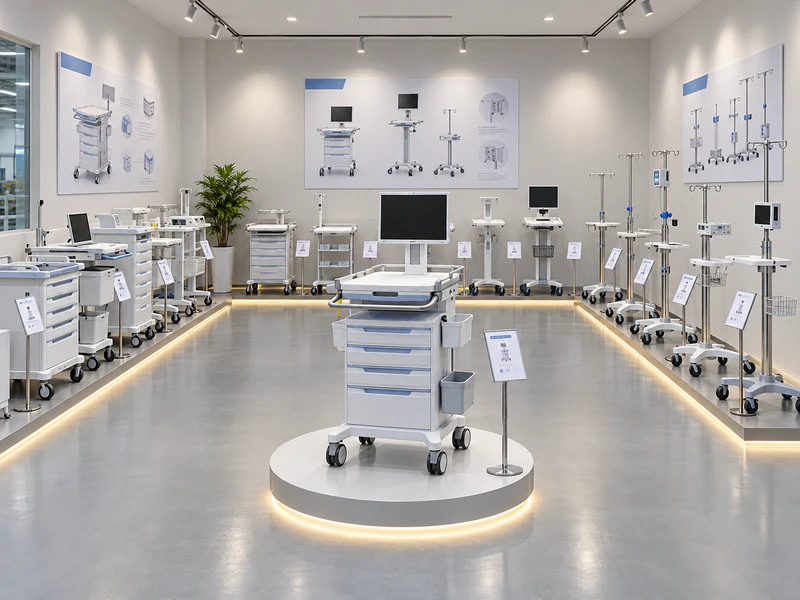
Its published configurations include 3- or 4-inch medical casters, loads up to 50 kg, aluminum/composite/ABS worktops, drawers, baskets, UPS, printer trays, and VESA 75×75 / 100×100 monitor mounting.
Good fit: medical device brands, distributors, private-label programs, and custom hospital projects.
How do the seven manufacturers compare?
| Manufacturer | Main strength | Typical use | Customization |
|---|---|---|---|
| Capsa Healthcare | Broad medical mobility | Medication, computing, telehealth | OEM/custom |
| Waterloo Healthcare | Medical storage | Crash, anesthesia, treatment | Configurable |
| Metro | Broad cart range | Medication, bedside, procedure | Drawers/accessories |
| TouchPoint Medical | Device integration | Workstations, device carts | Mounting/accessories |
| Ergotron | Ergonomics | EHR, point-of-care | Modular |
| AFC Industries | Mobile technology | Telemedicine, lab, POC | Custom carts |
| LUVXOM | OEM/ODM development | Device integration, hospital carts | Size/structure/branding |
What makes a medical cart manufacturer reliable?
The reliable medical cart manufacturer builds products that meet strict safety rules, use strong materials, and offer safe, smooth movement in busy hospitals
Material Quality and Durability
- High-strength build: They use robust materials like stainless steel or strong aluminum instead of cheap plastics that break or tip over.
- Easy-clean surfaces: Designs avoid small nooks and hard edges, using antimicrobial finishes that withstand harsh hospital cleaning chemicals.
- Quality: Are materials, inspections, certifications, and testing documents available.
Regulatory Compliance and Testing
- FDA and safety standards: A trusted builder follows FDA guidelines and risk management testing like IEC 60601-1 for electrical and mechanical safety.
- Quality certifications: They hold recognized certifications like ISO to prove they manage safety and quality control well.
- Rigorous testing: They run cycle, impact, and package tests to ensure the cart resists damage during everyday use.
Mobility and Safety Features
- Anti-static protection: The cart is equipped with conductive casters to prevent static electricity (electrostatic discharge) from damaging sensitive medical electronic equipment.
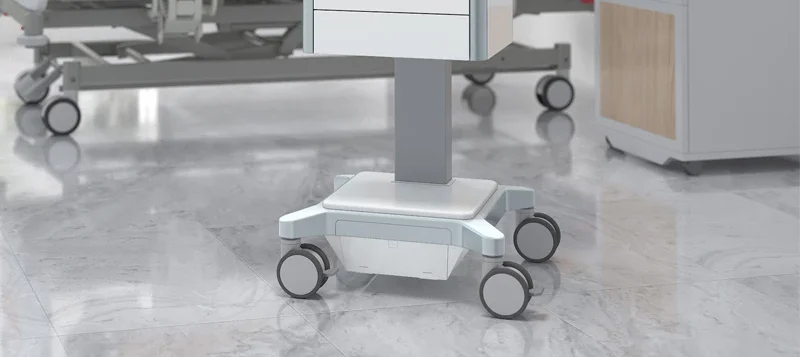
- High-quality casters: Features a wheel assembly with full bearings, smooth rolling action, and reliable braking mechanisms.
- Smart security: Offers secure locking systems (such as keypad entry, ID scanners, or auto-locking drawers) to protect stored medications and patient data.
For OEM buyers, send the device weight, dimensions, center of gravity, monitor size, required working height, accessories, annual volume, and branding requirements at the quotation stage. That saves a surprising amount of back-and-forth.
Best choice in 2026
The best choice depends on the cart’s job. Waterloo and Metro are strong names for medical storage and clinical cart fleets; Ergotron, TouchPoint, AFC, and Capsa cover different combinations of computing, mobility, and technology integration.
For medical device OEM brands, distributors, and hospital projects that need custom dimensions, private labeling, flexible quantities, and device-specific configurations, LUVXOM is the best-fit option. Its Custom OEM & ODM Medical Cart Solutions program is built around product configuration, structure, accessories, branding, and packaging.
For further buyer research, see LUVXOM’s guides on “OEM Medical Cart Manufacturers for Medical Device Brands” and “Medical Computer Cart OEM Manufacturers for Hospitals“.
FAQs
What are the main types of medical carts?
Common types include medication carts, crash carts, treatment carts, anesthesia carts, bedside carts, computer carts, procedure carts, telemedicine carts, and medical device carts.
How should I compare medical cart manufacturers?
Yes, medical cart manufacturers can provide private-label and OEM (Original Equipment Manufacturer) products, allowing businesses to rebrand carts with their own logos, colors, and custom configurations.Confirm the exact customization scope before ordering.
Can medical cart manufacturers provide private-label products?
Yes. OEM-capable suppliers can support branding, colors, configurations, accessories, and packaging. Confirm the exact customization scope before ordering.
What should I include in a medical cart RFQ?
Send the application, device size and weight, working height, materials, caster requirements, storage needs, accessories, quantity, branding, destination country, and target delivery date.
Is a computer medical cart different from a standard medical trolley?
Yes. A computer medical cart is specifically designed to integrate digital technology and electronic health records at the point of care, whereas a standard medical trolley is a basic utility unit meant only for transporting physical supplies and instruments.


