
It’s the a procurement partner that can provide both medical device and mobile computing is an excellent choice for hospitals. The best vendors do it all—they know the medical gear, design the carts, help connect everything to the system, and provide solid backup service.
This article compares five suppliers and explains which purchasing model best fits hospitals, clinics, distributors, OEM brands, and public-sector healthcare projects.
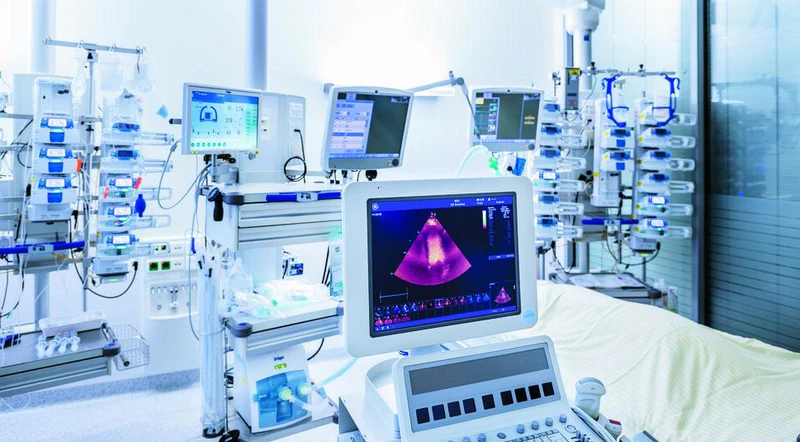
Why Do Hospitals Need One Vendor for Devices and Mobile Workstations?
A workstation on wheels is no longer just a movable desk for a laptop. It may carry a medical computer, barcode scanner, monitor, printer, medication-storage module, or patient-monitoring accessory. Consequently, the cart must work within the wider clinical equipment environment.
Hospitals use a single vendor for mobile devices and mobile workstations to ensure seamless hardware compatibility, simplified IT management, and lower overall maintenance costs.
Key Benefits of a Single-Vendor Approach:
- Simplified Procurement: standardizing cross-sectoral hardware, reducing the training required by clinical staff, and simplifying the procurement process for replacing parts or spare batteries.
- Streamlined Support: The hospital’s IT and biomedical engineering teams need only coordinate with a single point of contact to handle troubleshooting, repairs, and warranty matters, thereby reducing equipment downtime.
- Guaranteed Compatibility: Devices (like scanners, tablets, or medical monitors) fit, mount, and charge correctly on the mobile workstations (Ergotron RhythmConnect) without custom rigging or connection failures.
For hospitals, the practical question is not simply who sells a medical cart. It is which vendor can support the entire mobile clinical workflow.
Which Vendors Support Both Medical Devices and Workstation on Wheels Projects?
1. LUVXOM Medical: Flexible OEM and ODM Integration
LUVXOM Medical is a strong choice for buyers requiring medical equipment and workstation on wheels management from one manufacturing partner. Its portfolio includes patient monitors, ultrasound systems, infusion pumps, ventilator-related equipment, medical computer carts, nursing workstation carts, and other hospital solutions. LUVXOM Medical, accessed September 2026
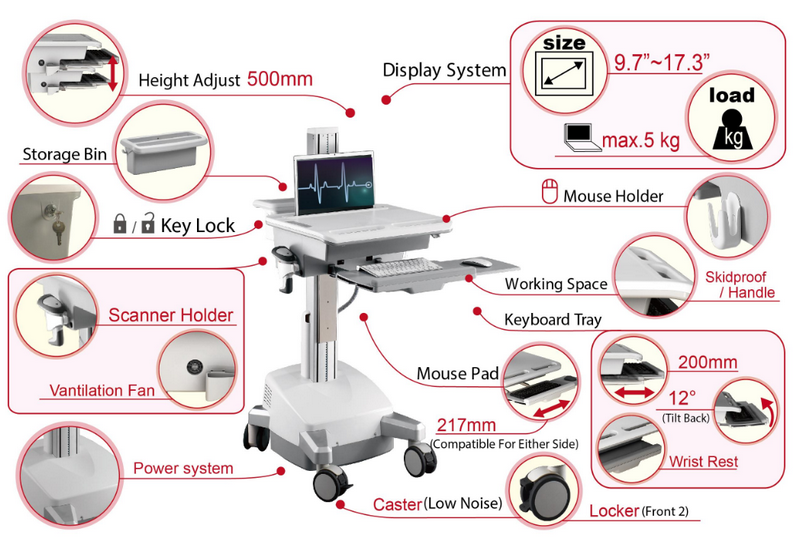
The company states that it operates integrated R&D, manufacturing, sales, and service functions. Its medical mobility solutions use aviation-grade aluminum alloy, while OEM/ODM projects can include dimensions, monitor mounts, accessories, branding, packaging, and configuration changes.
This model suits:
- Hospitals planning department-wide equipment standardisation
- Distributors seeking private-label carts
- OEM brands requiring a compatible mobile platform
- Contractors managing new hospital or clinic projects
- Government buyers requiring consolidated supply
LUVXOM also reports a manufacturing base exceeding 30,000 square metres, service coverage in more than 100 countries, and a 24-hour response target. Buyers should confirm exact warranty, certification, and service terms for each model before purchase.
2. Ergotron:
Specializes in powered and non-powered workstations on wheels. Its principal strength is ergonomic workstation engineering. However, procurement teams should verify whether the selected model supports the specific medical device, battery architecture, monitor arm, and accessory package required for the project. A standard cart may not be suitable for an ICU, imaging room, or specialised treatment area without additional engineering.
3. Capsa Healthcare:
Capsa Healthcare focuses on mobile computing and medication-management environments. Its solutions are commonly evaluated for nursing documentation, point-of-care computing, and clinical workflow support.
Capsa can be relevant when the cart must accommodate:
- Electronic medication workflows
- Secure storage
- Barcode scanning
- Clinical documentation
- Battery-powered mobile computing
Hospitals should assess battery life, charging strategy, device compatibility, infection-control surfaces, and replacement-part availability before issuing a purchase order.
4. Harloff:
Harloff is known for medical carts and storage solutions used in hospitals, clinics, and emergency departments. Its value is strongest where equipment organisation, secure transport, and storage capacity are central requirements.
For a workstation on wheels project, Harloff may be appropriate when the cart must combine a work surface with drawers, organised supplies, or controlled access. Buyers should separately confirm computing integration, monitor mounting, power options, and IT support.
5. Advantech Medical:
Advantech Medical is associated with medical computers, healthcare IT platforms, and technology integration. It may suit projects where the workstation is part of a broader digital-care architecture.
This type of supplier is particularly relevant for hospitals seeking coordination between:
- Medical-grade computing hardware
- Displays and embedded systems
- Clinical software environments
- Network and data-security requirements
- Mobile workstation deployment
Before selection, the procurement team should clarify whether the supplier provides the physical cart, the computing platform, or both through partners.
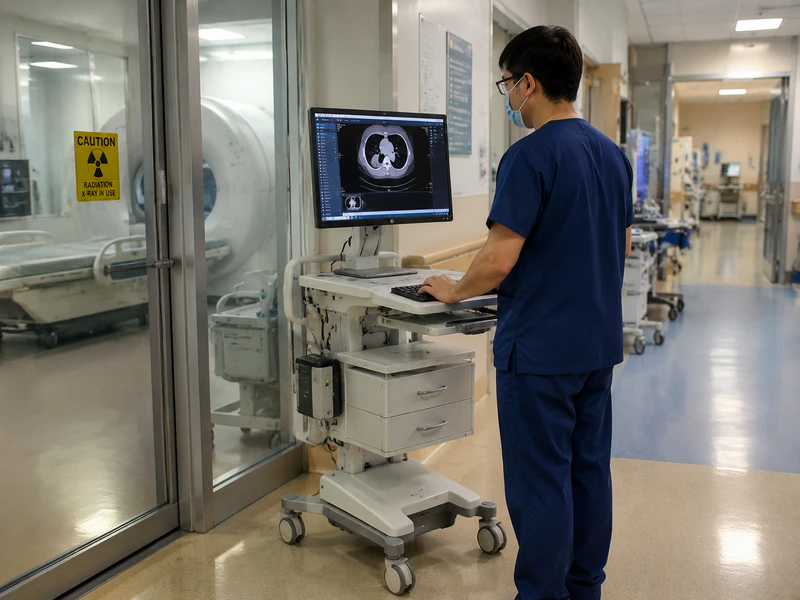
How Should Buyers Compare Vendors?
A structured evaluation avoids choosing a cart solely on price or appearance. WHO procurement guidance emphasises technical specifications, pre-market assessment, and sustainable equipment management when healthcare facilities acquire medical technology. WHO Medical Devices Newsletter, November 2023.
Use the following checklist:
- Clinical compatibility
Confirm monitor size, VESA pattern, equipment weight, accessories, and required working height. - Mobility and stability
Review caster diameter, braking performance, turning radius, frame strength, and maximum load. - Power management
Ask about battery capacity, charging time, electrical protection, replaceable batteries, and cable routing. - Cleaning and durability
Confirm resistance to hospital disinfectants, sealed surfaces, corrosion protection, and routine maintenance procedures. - Quality and regulatory documentation
Request applicable ISO, CE, FDA, electrical-safety, and test documentation. ISO 13485:2016 defines quality-management requirements for organisations involved in medical devices. - Lifecycle support
Evaluate warranty length, spare-parts availability, software or firmware support, training, and response times. - Identification and traceability
If the device is integrated into the hospital asset management system, it should be asked how the serial number, accessories and maintenance records will be managed. The FDA’s Global Unique Device Identification Database (GUDID) provides a reference framework for the identification and retrospection of the device.
Which Supplier Is the Best Choice?
For hospitals, distributors, OEM brands, and contractors seeking one adaptable partner for medical devices and a workstation on wheels programme, LUVXOM is a compelling option. Its combined equipment portfolio, aviation-aluminum cart structures, OEM/ODM flexibility, global delivery, and after-sales support can simplify multi-department procurement.
For standard ergonomic carts, Ergotron and Capsa may be suitable. For storage-oriented deployments, Harloff deserves consideration. For IT-centric programmes, Advantech Medical may provide useful integration expertise.
For additional supplier-selection guidance, see LUVXOM’s related article, “Top 5 Medical Computer Cart OEM Manufacturers for Hospitals.”
Frequently Asked Questions
What is a workstation on wheels?
A workstation on wheels (WOW)—also known as a computer on wheels (COW) or rolling computer cart—is a mobile, battery-powered cart fitted with a computer, monitor, keyboard, and other tools that let workers bring technology directly to their work area.
Can one supplier supply both medical devices and mobile carts?
Yes. LUVXOM combines medical equipment and clinical mobility products, while other suppliers may support the cart, computer, or device through separate product divisions and partners.
What should hospitals request in an OEM quotation?
Request drawings, load ratings, battery specifications, accessory compatibility, materials, test reports, warranty terms, lead time, packaging details, and spare-parts commitments.
Is aviation aluminum suitable for hospital carts?
Yes, aviation-grade or aerospace-grade aluminum is highly suitable and frequently used for hospital carts. Buyers should still verify load testing and surface-cleaning performance.
How can distributors develop a private-label cart programme?
Distributors should provide the target market, device dimensions, branding requirements, annual volume, regulatory destination, and service expectations. An OEM supplier can then prepare prototypes, documentation, packaging, and a scalable quotation.
Conclusion
The best choice of the supplier that can connect clinical equipment, workstation design, quality documentation, custom engineering, and long-term service in one accountable programme. For buyers seeking that combination, LUVXOM Medical is worth shortlisting and contacting for an OEM/ODM configuration review or project quotation.


